
Keep-It-Simple Financial Planning (Part 1)

When you look at your finances, do you feel empowered or depressed? There are few things in our personal lives that run to such extremes as our finances. Do you understand how to pay off your debts? Will you be ready for your retirement? Will you be able to retire? Do you get calls from collection agents because you have late bills? When an investment advisor tells you they have the perfect investment, do you know how to do the research yourself, or do you blindly follow along and get burned when the “hot” investment fails? If any of these are true for you, then I have good news: you can live comfortably now, pay off your debts, and prepare for unexpected problems in the future.
Humans live with an insatiable amount of desires. We have more desires than we have resources to fulfill them. Bill Gates, the richest person in the world, has them; I have them; and if you examine yourself carefully, you will find that you have them too.
There are two ways to deal with all of these desires: we can spend for every desire regardless of our income, or we can think about what we really want, control ourselves, and make a plan to reach our real goals and desires. The first option will cause us to dig a financial hole that may be impossible to climb out of. The second option allows us to achieve our true goals and helps us gain financial freedom.
Striving to follow the common-sense notion of “plan and save” is hard because there are people constantly trying to convince us that there are things we need now. They use phrases like:
- “You Deserve It!”
- “No Money Down!”
- “Thirty Days Same as Cash”
- “Buy Now, Pay Later”
- “Buy with your _____ Card and Save 10%!”
These messages are powerful siren songs that lure people away from their paths.
Economists talk about how people choose between desires in terms of utility. For example, when we have a dollar and choose to get ice cream over candy, we have decided that—at the time—ice cream has a higher utility to us than candy. Sometimes, the messages above convince us of utilities that may drive us into debt.
So, is debt bad? The answer is yes and no. Debt is a tool that can be used to accomplish good in your life. It can help you get through school or buy a house or car. Debt can also be bad if you are spending more than you make; eventually, you will be unable to pay it off. Then you can lose your home, your car, or ruin your credit, which is your ability to gain new loans.
There is an old saying in the business world:
“Those who understand interest, collect it; those who do not, pay it.”
When you take on a debt, the debt amortizes. This means you have the same payment for the length of the loan, but the portion of the payment that is interest is greater at the beginning. For example, if Mr. Jones buys a house for $200,000 at 15% interest over 30 years, each of his payments will be divided between interest and principal. Principal is the part of the payment that actually repays the loan. Interest is pocketed as profit by the lender. On this loan, he will pay $2,528.89 a month. In the first month, he pays $2,500 in interest and $28.89 in principal. In the last month, he pays $31.20 in interest and $2,496.30 in principal. Over 30 years, he will pay $710,398.31 in interest. The process of amortization is usually expressed in a table, starting with the first month of the loan and ending with the last month. Interest each month is figured by multiplying the monthly interest rate by the remaining balance after paying principal the previous month. Your loan’s Annual Percentage Rate (APR) is found by multiplying your monthly rate by twelve. We’ll revisit this later.
Because finances are so important, we need to track them and know where we are at all times. I suggest keeping all financial information in at least two places. You can make a finance section in your planner, keep it in a separate folder in your office, on your computer, etc. This information is too valuable to lose and should be easily accessible when needed.
Decorate your financial planner with images that show why you are motivated to stay on top of your finances and create a plan to get and stay out of debt. Suggestions could include pictures of family, images representing your dreams, and life goals. Ensure all important financial papers are kept in a safe place that would survive a major natural disaster.
Possible contents of a financial planner section
- Net Worth Analysis – a summary of what you own versus what you owe.
- Get Out of Debt Plan – a written plan to pay off your debt.
- Monthly Budgets – for tracking finances throughout the month.
- Bill Tracker – list all bills in one place with payment amounts.
- Financial Plan – your overall plan to reach financial goals.
- Account Summary – regularly updated listing of balances on debts, bank, and investment accounts.
Remember, this should be your planner. Make it what you need to be successful.
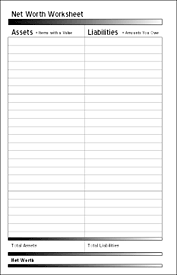
The first step in starting your financial plan and getting out of debt is to conduct a Net Worth Analysis. It’s a snapshot of your current financial position. List what you own (assets) and subtract all your debts (liabilities). I have made a sheet for this exercise called the Net Worth Worksheet. Print it out; it’s included in the zip file attached below, containing a PDF document and its source file, created in OpenOffice.org Draw.
Assets include items that make or can be converted to money easily. Examples:
- Houses
- Automobiles
- Computers
- Furniture
- Income – record post-tax monthly income and multiply by twelve to get yearly income.
List all liabilities – anything that takes money away, including bills and debts. Multiply monthly bills by twelve to get annual amounts. Sum all liabilities under Total Liabilities.
Subtract liabilities from assets. If the number is positive, you have more assets than liabilities; if negative, you have more liabilities than assets. You now know exactly how much money you owe, to whom, and what it will take to pay them off. With this knowledge, you can create a full plan to get out of debt in Part 2.
Download
NetWorth.zip – 42.25 KB
Subscribe via RSS